
Introduction
Water hardness is one of the most common problems in the water supplied to factories. High hardness causes scale formation in boilers, heat exchangers, pipelines, and RO membranes, significantly increasing maintenance and repair costs.
An industrial water softener is a device that reduces water hardness by removing calcium and magnesium ions.
What Does Water Hardness Mean?
Water hardness is mainly caused by the presence of calcium (Ca2+) and magnesium (Mg2+) in water. These ions combine with carbonates and sulfates to form white, hard deposits known as limescale.
How Does a Resin Water Softener Work?
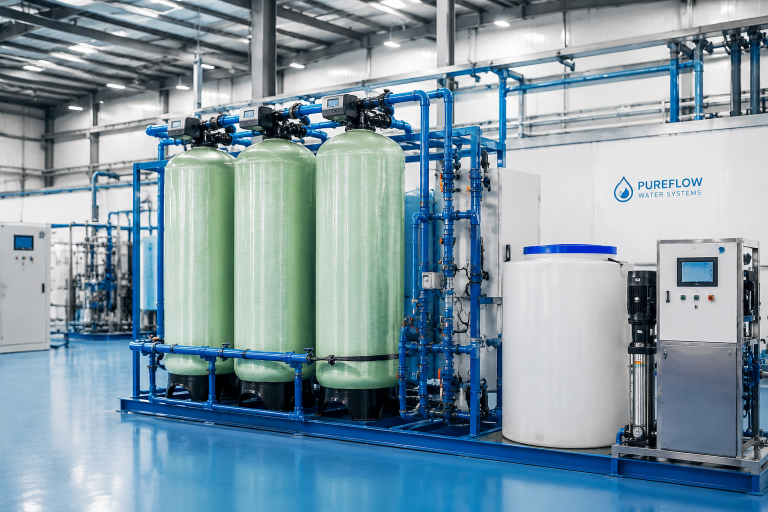
In this system, water passes through a bed of ion-exchange resins. The negatively charged resin beads attract calcium and magnesium ions and release sodium ions (Na+) in their place. As a result, the outlet water becomes softer.
Regeneration Stage
After some time, the resin’s capacity to absorb hardness is exhausted. At this stage, a sodium chloride brine solution is passed through the resin bed, flushing out the calcium and magnesium ions and restoring the resin for reuse.
Types of Industrial Water Softeners
content_copy
| Type | Key Feature | Application |
|---|---|---|
| Resin Softener | High precision, salt regeneration | Boilers, RO systems, closed-loop systems |
| Magnetic Softener | No chemical consumption | Simpler systems and piping lines |
| Thermal Softener | Temporary hardness removal | Large steam boilers |
Why Is a Softener Important in RO Pre-Treatment?
High hardness causes scaling and fouling on the RO membrane surface and reduces system efficiency. Installing a proper softener before RO increases membrane lifespan and lowers maintenance costs.
Conclusion
A water softener is one of the key components of pre-treatment in factories. Choosing the right type and capacity depends on the inlet water hardness, flow rate, and industry type.
Zhiyar Ab Sanat provides the design and installation of resin softeners and all industrial pre-treatment equipment.

No comments yet.