
Introduction
Water is one of the most important inputs in any industrial process—from boilers and cooling towers to food, pharmaceutical, and textile production lines. However, tap water or well water is rarely suitable for direct use in these processes without prior treatment.
Industrial water treatment refers to a set of processes designed to remove impurities from raw water—including suspended solids, hardness, salts, heavy metals, dissolved gases, and microorganisms—so that the treated water reaches a quality level that does not damage the production process, equipment, or final product.
Why Do Factories Need Industrial Water Treatment?
Direct use of raw water in industry can lead to serious consequences:
- Scale formation and corrosion in boilers and heat exchangers
- Reduced efficiency of cooling equipment and RO systems
- Premature failure of pumps, valves, and piping
- Compromised final product quality in the food, pharmaceutical, and beverage industries
- Increased energy and maintenance costs
With a properly designed water treatment system, these risks are reduced and equipment service life is extended.
Main Components of an Industrial Water Treatment System
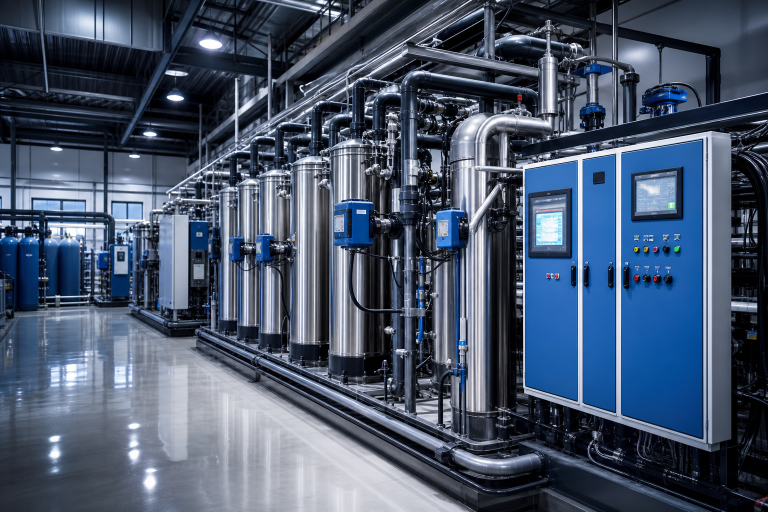
An industrial water treatment line typically includes the following sections:
Pre-Treatment
Removal of large particles, sediment, chlorine, and water hardness. This stage includes sand filters, carbon filters, and water softeners.
Main Treatment
Usually carried out using reverse osmosis (RO) or ultrafiltration (UF) systems, this stage removes salts, ions, and dissolved contaminants.
Post-Treatment
Includes UV, EDI, or polishing filters to achieve the final water quality required by the industry.
Common Industrial Water Treatment Methods
| Method | Main Application | Treatment Stage |
|---|---|---|
| Sand Filter | Removal of suspended solids | Pre-treatment |
| Carbon Filter | Removal of chlorine, odor, and organic matter | Pre-treatment |
| Resin Water Softener | Reduction of water hardness | Pre-treatment |
| Reverse Osmosis (RO) | Removal of salts and TDS | Main treatment |
| Ultrafiltration (UF) | Removal of colloids and microbes | Main treatment |
| EDI | Production of ultra-pure water | Post-treatment |
Conclusion
Industrial water treatment is not just an expense; it is an investment in protecting equipment, reducing energy consumption, and ensuring production quality. Choosing the right system depends on the type of industry, the quality of the inlet water, and the required outlet water standard.
Need consultation? The experts at Zhiyar Ab Sanat are ready to review your factory water analysis and propose a suitable treatment solution.

No comments yet.