

With the growing scarcity of freshwater resources and the urgent need to reduce operational costs across various industries, advanced water reuse and treatment technologies have become a strategic necessity. Among all separation and purification methods, Reverse Osmosis (RO) is widely recognized as the gold standard in industrial water treatment.
The beating heart of any industrial water treatment package is the membrane—an exceptionally sensitive and engineered component upon which the quality of the permeate and the overall lifespan of the system directly depend. In this article, we explore the mechanism of industrial water treatment, the structure of RO membranes, and critical tips for maximizing their lifespan.
What is Industrial Reverse Osmosis (RO)?
Osmosis in nature is a process where water flows from a lower concentration solution to a higher concentration solution through a semi-permeable membrane until concentrations are balanced on both sides.
In industrial reverse osmosis, this process is reversed. By applying high mechanical pressure (using multi-stage high-pressure pumps) that exceeds the natural osmotic pressure, raw or saline water is forced through a semi-permeable membrane. The pores of this membrane are extremely fine (approx. 0.0001 microns), allowing only pure water molecules to pass while rejecting up to 99% of dissolved solids (TDS), harmful ions, salts, heavy metals, bacteria, and viruses, flushing them out through the reject line.
Industrial RO Membrane: Structure and Operation
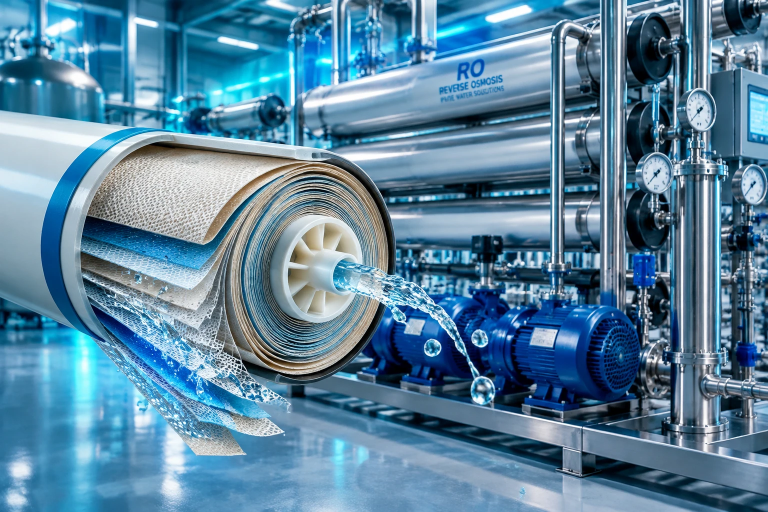
Industrial membranes are typically made of Thin Film Composite (TFC) polyamide materials. These membrane sheets, along with feed spacers and permeate collection layers, are wound spirally around a central collection tube and housed inside a protective pressure vessel (usually made of fiberglass).
Key Features of Standard RO Membranes:
- High Filtration Precision: Effectively removes monovalent and divalent ions such as sodium, chloride, calcium, magnesium, sulfate, and nitrate.
- Standard Industrial Sizes: Primarily available in 4-inch (4040) for small-to-medium capacities and 8-inch (8040) for high-capacity industrial demands.
- Specialized Types:
- BW (Brackish Water): Designed for medium TDS well water and general brackish sources.
- SW (Sea Water): Engineered to withstand high pressures (up to 70 bar) for seawater desalination.
- ULP / XLE: Low-pressure, energy-saving membranes designed to reduce pump energy consumption.
- FR (Fouling Resistant): Specialized membranes designed for water sources containing high organic matter or treated wastewater.
Applications of Industrial RO Systems
Depending on the specific requirements of an enterprise, RO systems produce water with tailored electrical conductivity (EC) and hardness levels. The major industries relying on RO-treated water include:
- Power Plants & Boilers: Supplying mineral-free water to prevent severe scaling and corrosion in boilers and turbines.
- Pharmaceutical & Healthcare: Producing high-purity water (PW and WFI) for drug formulation, serums, and hygiene products.
- Food, Beverage & Dairy: Ensuring standard taste, product clarity, extended shelf life, and formulation consistency.
- Oil, Gas & Petrochemical: Supplying high-quality makeup water for cooling towers and chemical processes.
- Modern Agriculture & Hydroponic Greenhouses: Precise control of water EC to optimize nutrient absorption by plant roots.
The Importance of Pre-Treatment for Membrane Health
Despite their exceptional performance, RO membranes are highly vulnerable to specific contaminants. The ingress of suspended solids, turbidity, or free chlorine can cause irreversible damage in a short period. Therefore, proper pre-treatment design is crucial:
- Sand and Carbon Filters: Sand filters remove suspended solids, turbidity, and silt; activated carbon filters play the vital role of removing free chlorine (as chlorine causes immediate oxidation and destruction of the polyamide membrane skin).
- Micro-Cartridge Filters: The final physical defense barrier (typically 5 microns) to prevent any particulate matter from entering the high-pressure pump and membrane elements.
- Anti-scalat Dosing: A critical chemical treatment that prevents the crystallization of calcium and magnesium, avoiding mineral scaling on the membrane surface.
Signs of Fouling and CIP (Cleaning In Place)
Over time, the membrane surface is exposed to mineral scaling, organic fouling, or biological growth. Periodic chemical cleaning, known as CIP (Cleaning In Place), is an essential part of system maintenance.
Signs Indicating the Need for Cleaning or Membrane Replacement:
- A 10% to 15% drop in permeate production flow.
- A significant increase in operating pressure or differential pressure (ΔP) across the membrane stages.
- An increase in permeate TDS or a decrease in salt rejection percentage.
Key Note: If CIP is not performed timely and according to the specific foulant type (using acid for mineral scales and alkaline for organics), the fouling becomes permanent, requiring membrane replacement.
Conclusion: A Smart Investment Through Proper Selection
Utilizing an industrial reverse osmosis water treatment system goes far beyond simple filtration—it safeguards production lines, protects expensive industrial assets (such as steam boilers and chillers), and reduces maintenance overhead.
Choosing reputable membrane brands (such as FilmTec, Toray, Hydranautics, and LG Chem), combined with precise pre-treatment engineering and regular water parameter monitoring, ensures the highest efficiency and longest operational lifespan for your reverse osmosis system.

No comments yet.